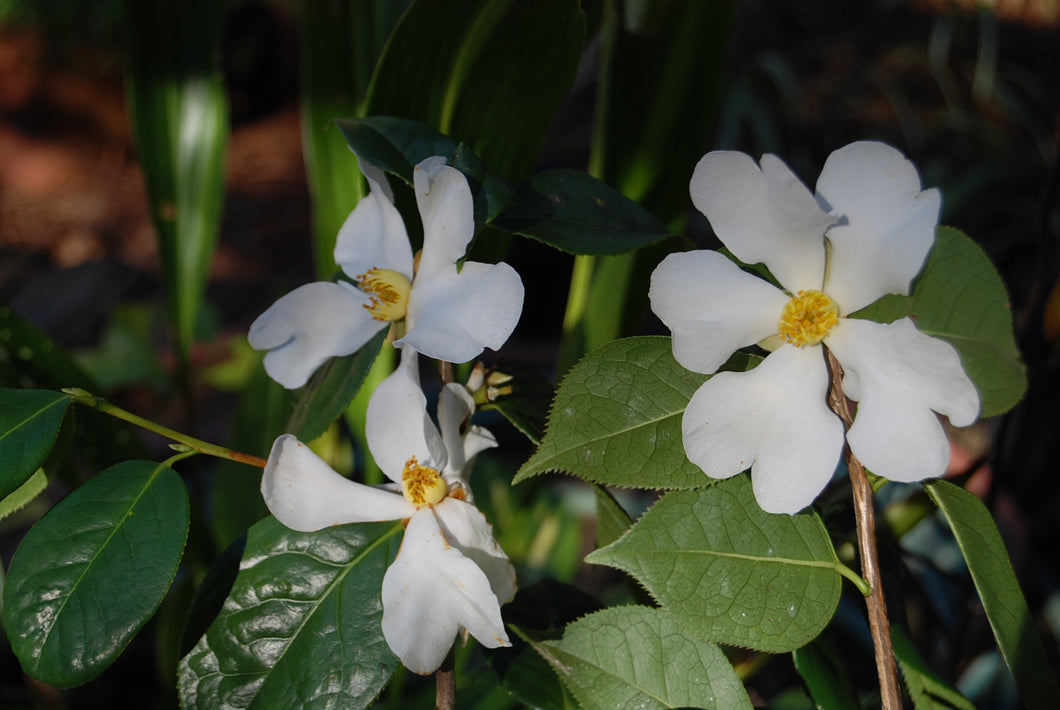
ABG Select Camellia. I was introduced to this Camellia species by Jamie Blackburn of the Atlanta Botanical Garden. He had acquired a seedling of this species from Camellia Forest Nursery, Chapel Hill, NC. The foliage is very similar in size to that of C. japonica. But its most endearing characteristic is its abundant display of 2.5-3.75" white flowers with yellow stamens. The flowers are produced in such profusion that it will blow your mind. When in full flower from November to January and beyond, one can see that the foliage is almost hidden by the abundant, single, white flowers. Camellias are not well known for their fragrance, but this species is purported to be one of the more fragrant. outstanding. But, I tend to agree with Abbie Jury from New Zealand in Abbie's Column online: "Some reports mention an overwhelming fragrance, but we think that either that claim is exaggerated, the Chinese have greatly sensitized nasal capacities or the clone we grow here didn’t get much fragrance. It is really only lightly scented and that requires sticking one’s nose right up to the bloom." I am tending to think that there is great variation from plant to plant in the degree of fragrance. With this selection, we tend to get multiple flower buds at each node! It has a very dense habit and we are not sure of the ultimate height of this selection. But so far, our observations are that it will be about as broad as high. So, this selection has been grown from cuttings, consequently it will remain more shrub-like and probably wont get as large as the seed grown species. This is one of the parents to Camellia 'Yume' and has passed its fragrance over to this cultivar. As a matter of fact, I consider 'Yume' as much more fragrant than any of our selections of C. yuhsienensis. This species is principally grown in China as an oil-producing species, where some studies have shown that the oil from this species to be among the best of the edible-oil Camellia species. I can't imagine what a production field of this species must look like in China when it is in full flower. The monograph on the genus Camellia, COLLECTED SPECIES OF THE GENUS CAMELLIA, states that C. odorata and C. yuhsienensis should be considered synonymous.
Zones 7-9